


Everyone got faster
Teams ship faster. Individuals produce more. The tools are working — but the roadmap barely changes.
- Local productivity
- Tool adoption
- Private wins
Many product organizations have adopted AI. Individuals do faster research, writing, and analysis, and increasingly let AI agents act on live systems.
However, many organizations get stuck here.
Personal agents can feel transformational. But the real transformation only begins when AI becomes part of a shared product operating model.
Teams ship faster. Individuals produce more. The tools are working — but the roadmap barely changes.
AI maturity is not defined by which models you use or how many agents you have. It is visible in how your organization makes product decisions, carries context into delivery, validates outcomes and retains what it learns. There are four recognizable stages.
| Stage | L1 Personal chat AI Product people use AI for research, synthesis, writing, analysis and everyday tasks. The person remains the integration layer. They decide what context to provide, what answer to trust and what to carry into the next task. The organization gains productivity, but almost none of the resulting capability is institutionalized. L1Personal chat AI | L2False summit Personal agents Agents move beyond answering questions. They work on real documents, repositories, tickets, analytics and workflows. This feels transformational because the jump in personal capability can be enormous. But the operating model has barely changed. Each person still brings their own context, agents, prompts, tools and judgment. The organization becomes faster locally without becoming more coherent globally. This is the false summit. L2False summitPersonal agents | L3 Team product loop AI stops being a collection of personal workflows and becomes part of how a product team operates. One team works from shared context. Outcomes and success metrics are explicit. Decisions and evidence persist. Agents operate inside defined boundaries. Human review points are clear. Delivery is followed by validation, and what was learned influences the next decision. For the first time, the benefit can compound beyond the individual. L3Team product loop | L4The destination AI operating model Several teams work through compatible product loops. Repeated capabilities become shared services instead of being rebuilt by every team. Context, evaluation and governance are designed into the system. Ownership is explicit. Outcomes, costs and quality can be compared. Decisions and learning remain traceable. AI is no longer something employees use. It has become part of how the organization runs product. L4The destinationAI operating model |
|---|---|---|---|---|
| What changes | AI assists the individual | Agents act for the individual | AI becomes part of how one team works | The operating model works across teams |
| Context | Personal | Personal | Shared within a team | Shared and reusable across the organization |
| Capability ownership | Individual | Workflow | Team | Organization |
| Value | Faster tasks | Faster individuals | Better product loops | Compounding organizational capability |
| Status | Starting point | The false summit | Working operating model | The destination |
Product people use AI for research, synthesis, writing, analysis and everyday tasks.
The person remains the integration layer. They decide what context to provide, what answer to trust and what to carry into the next task.
The organization gains productivity, but almost none of the resulting capability is institutionalized.
Agents move beyond answering questions. They work on real documents, repositories, tickets, analytics and workflows.
This feels transformational because the jump in personal capability can be enormous.
But the operating model has barely changed.
Each person still brings their own context, agents, prompts, tools and judgment. The organization becomes faster locally without becoming more coherent globally.
This is the false summit.
AI stops being a collection of personal workflows and becomes part of how a product team operates.
One team works from shared context. Outcomes and success metrics are explicit. Decisions and evidence persist. Agents operate inside defined boundaries. Human review points are clear. Delivery is followed by validation, and what was learned influences the next decision.
For the first time, the benefit can compound beyond the individual.
Several teams work through compatible product loops.
Repeated capabilities become shared services instead of being rebuilt by every team. Context, evaluation and governance are designed into the system. Ownership is explicit. Outcomes, costs and quality can be compared. Decisions and learning remain traceable.
AI is no longer something employees use.
It has become part of how the organization runs product.
Individual AI adoption creates real gains. But without an operating model, those gains remain fragmented — and the bigger opportunities stay out of reach.
People use AI to be faster at their work.
Agentic capabilities are shared and compounding.
More AI usage, more output.
Better outcomes, higher product value.
AI adoption without operating-model change creates a new kind of organizational debt.
Most organizations do not get stuck because they lack AI usage. They get stuck because usage spreads faster than operating-model change.
If these feel familiar, you are probably not lacking AI adoption. You are encountering a maturity constraint.
The next step is not another AI tool. It is an operating model that turns individual acceleration into organizational capability.
Organizations rarely move forward evenly. You may have sophisticated engineering agents and weak product measurement. One team may already work from excellent shared context while another is still operating from personal chats. That is why maturity should not be assessed by counting tools. It should be assessed across five drivers.
What is AI supposed to improve?
At low maturity, AI adoption is driven primarily by available tools and personal productivity.
At higher maturity, AI capabilities are explicitly connected to product outcomes, strategic priorities and the way the organization wants product decisions to be made.
Who owns the decisions around agentic work?
Maturity requires more than AI skills.
It requires clear accountability: who sets an outcome, who can delegate work, who approves critical decisions, who intervenes when confidence is low and who owns what happens after release.
Can people and agents work from the same current reality?
The critical infrastructure is not simply access to a powerful model.
It is access to the right evidence, decisions, constraints, product intent and history — in a form that can survive beyond an individual conversation.
Where does AI sit in the way product work actually happens?
At low maturity, AI sits beside the process.
At higher maturity, it becomes part of a repeatable loop connecting discovery, prioritization, definition, delivery, validation and learning.
Can you tell whether the system is producing value — and whether it is behaving as intended?
Mature organizations can connect agentic work to outcomes, evaluation, cost, risk and accountability.
Governance becomes part of the workflow instead of a review performed after the work has already happened.
Personal chat AI
AI maturity is the shift from individual productivity to organizational capability
Capability moves from Individual to Organization.
Capability lives with
AI accelerates research, analysis and production. But context, judgment and learning still live with the individual. Valuable productivity — not yet an operating model.
Individuals work faster
Product Manager
Finds insights, writes PRDs, analyses feedback.
ChatGPT
Research, synthesize, draft, iterate.
Faster insights
Hours → minutes
Researcher
Analyses data, summarises papers, finds patterns.
Claude
Read, analyse, summarise, compare.
Faster research
Hours → minutes
Marketer
Creates content, analyses campaigns, tests ideas.
Gemini
Draft, adapt, brainstorm, refine.
Faster content
Hours → minutes
No carryover to org
The organization
No shared memoryDocs
Scattered files and drafts
Notes
Personal notes and highlights
Analyses
One-off analysis and exports
Decisions
In individual inboxes
Outputs
Isolated deliverables and content
Learnings
Stay in people's heads
Same organization. No durable system.
What changes
Individuals can compress hours of research, synthesis and production into minutes.
What still breaks
Context is reconstructed, quality varies, and little of what was learned becomes reusable.
Move up when
The next step is not better prompting. It is giving agents bounded work they can execute repeatedly.
L1 accelerates tasks. L2 starts delegating them.
Capability lives with
At L2, AI has moved beyond experimentation. Agents are touching real systems. Product managers can compress hours of analysis into minutes. Researchers synthesize more evidence. Engineers ship at a pace that would previously have seemed unrealistic.
The organization can point to impressive examples everywhere.
And yet very little of that capability belongs to the organization.
It belongs to individuals.
Which frictions in checkout cost us the most conversion?
Rank them by impact.
What do the 12 interviews say about people abandoning checkout?
The three sharpest quotes, please.
Which dependencies put the Q4 roadmap at risk?
Sort them by when they hit.
Where do the latest competitor releases beat our positioning?
Two sentences, for the launch page.
The false summit is the point where local AI capability becomes strong enough to hide the absence of an operating model.
The signs are usually recognizable.
| What leadership sees | What is actually happening |
|---|---|
| Teams are moving faster | Output is accelerating faster than decision quality |
| Everyone has AI tools | Everyone has a different context |
| Agents are doing real work | Responsibility for their work is still informal |
| Many workflows exist | Few capabilities are reusable |
| AI spending is increasing | Value and cost are difficult to connect |
| More things are being shipped | Validation and learning have not accelerated equally |
The solution is not to centralize every prompt or force every team onto a single agent.
It is to make the important parts of product work shared and explicit.
Shared outcomes. Shared evidence. Durable decisions. Clear boundaries. Human approval where judgment matters. Measurement after release. Learning that reaches the next decision.
That is the move from L2 to L3.
Capability lives with
The move from L2 to L3 is smaller than an enterprise transformation — and more important than another round of tool rollout. You establish one working product loop with one real team.
This creates something personal AI cannot create:
organizational memory.
The loop gets better because it retains evidence from previous loops.
The team gets faster because it stops reconstructing the same context.
Decisions become easier to challenge because their reasoning is visible.
AI work becomes easier to govern because ownership and boundaries are part of the workflow.
And management can finally distinguish activity from impact.
Capability lives with
An AI Product Operating Model does not mean that every product team works identically. It means teams no longer have to reinvent the underlying system required to work effectively with agents.
Each keeps its own product decisions.
A team can draw on trusted context instead of assembling it from scratch.
A product manager can use established evaluation patterns instead of inventing a quality check for every workflow.
Common agent capabilities can be maintained once and reused many times.
Leadership can see where AI is producing outcomes, where cost is accumulating and where intervention is required.
Governance requirements can appear inside the product workflow as boundaries, checks and approvals rather than arriving at the end as paperwork.
Product decisions remain human-accountable while more of the work surrounding those decisions becomes machine-executable.
And the result of one loop improves the next.
That is the point of the maturity model.
Not maximum automation.
A product organization that can make better decisions, execute them faster and learn from the result — repeatedly.
Trying to design the final enterprise operating model before proving one working loop usually creates architecture without evidence. The safer path is to move one level at a time.
AI Product Maturity Assessment
Know where you actually stand
Map how product decisions are currently made.
Look at the evidence they use, where context lives, how work reaches delivery, where humans intervene and what happens to the result after release.
The purpose of the assessment is not to award a maturity score.
It is to find the constraint that prevents the next level.
Outcomea current-state maturity map, the first constraint and a decision about what to test.
Open the assessment
Product Team Enablement
Make agentic product work deliberate
Where teams are still learning how to direct and evaluate agents, establish the practices and artifacts they need to work deliberately.
The objective is not prompt training.
It is the ability to give an agent useful context, explicit intent and boundaries — and to judge what comes back against evidence.
Outcomea team capable of working deliberately with agents and the first artifacts worth reusing.
The enablement is delivered by our vetted training partners at agenticpm.de, held to the same bar as our own work. You book there, and you can still come to us at any point — and if you do not know your constraint yet, start with the assessment.

Operating Model Pilot
Build one complete team product loop
Choose a bounded product problem and run one full loop.
Start with the outcome. Establish shared context. Define ownership and gates. Connect the work to delivery. Measure what happens after release.
Do not ask whether the pilot produced an impressive demo.
Ask whether this way of working produced better evidence for the next decision.
Outcomeone functioning L3 product loop and evidence about what should — or should not — scale.
How it connects to delivery
Rollout & Scale
Turn proven practices into organizational capability
Only scale what the pilot has justified.
Repeated context patterns become services. Common evaluation becomes reusable. Ownership becomes explicit. Observability and governance expand with adoption.
Teams should gain leverage without losing responsibility for their product outcomes.
Outcomereliable agentic product work across teams rather than a collection of successful local experiments.
What operations require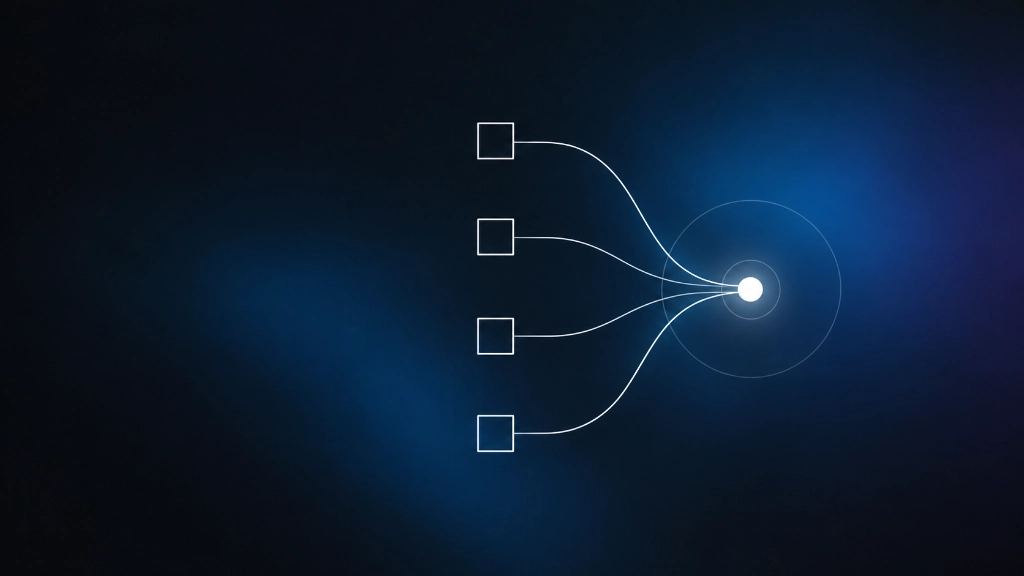
An operating model does not start with a mandate. It starts with one loop that works. The Center of Excellence approach (CoE) turns that proof into shared capabilities — then transfers delivery outward as teams become ready to carry it.
When expertise is scarce and standards do not yet exist, they need one home. The CoE forms around a real product problem, proves the loop end to end, and codifies what works.
As teams mature, delivery moves outward. What stays central is what benefits from scale: platform, security baseline, golden paths, diagnostics and enablement.
Two models fail: a centre that governs without shipping, and a centre that becomes the queue for every AI initiative. A strong CoE does neither. It transfers capability instead of accumulating work.
A CoE is a lever on the whole organization's AI maturity. It gains reach by having to own less: maturity comes from proven practice, not from decree.
The move from one capable team to a capable organization happens through replication: prove it, codify it, transfer it, repeat. Nothing scales before it has worked somewhere.
Strategically, it defines the AI Product Operating Model. Tactically, it proves and refines it through real delivery. As maturity grows, shared capabilities scale and execution federates into the organization.
CoE maturity
It is:
What happens to a product decision after the AI gets involved?
Those answers reveal more about AI maturity than the number of licences, models or agents in the organization.
And they usually reveal the next move.
The AI Product Maturity Assessment maps how product work operates today, identifies the maturity constraint and defines the smallest useful step toward the next level.
Not a transformation roadmap.
Not a technology selection exercise.
A way to determine where your organization stands — and what needs to become true next.
The AI Product Operating Model connects product decisions, agentic delivery and validation in one repeatable system.